
dexpot
Synchronous Python APIs that adapt concurrency to the interpreter.
One application. Two interpreter modes.
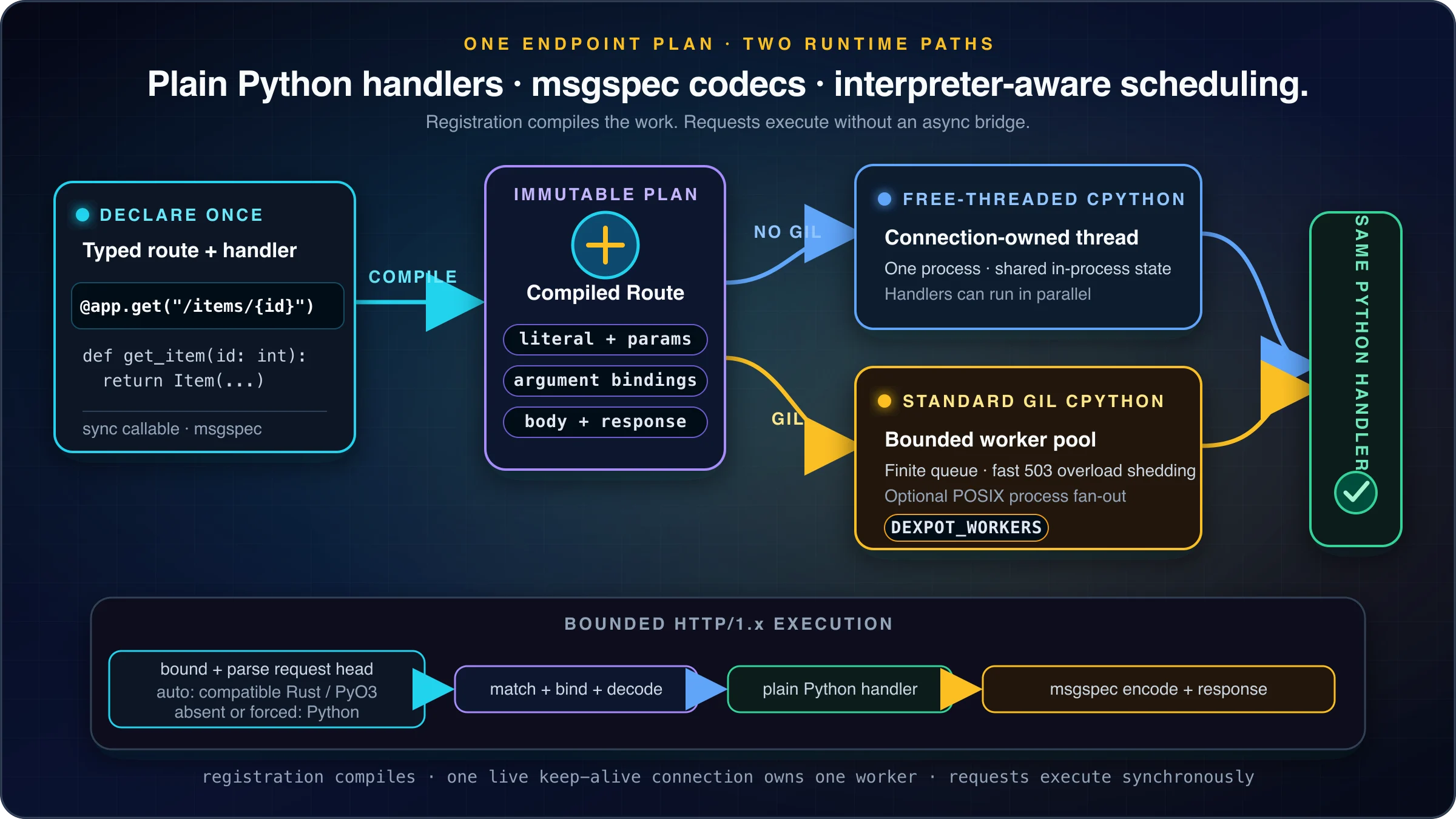
Section titled “One application. Two interpreter modes.”Dexpot keeps application code synchronous while changing admission and scheduling around the interpreter that runs it.
| Runtime | Serving model | Overload behavior |
|---|---|---|
| Free-threaded CPython | One process; each admitted connection owns a thread | A process-wide active-connection cap sheds excess work before thread creation |
| Standard GIL CPython | A bounded pool of connection-owning threads | A bounded queue sheds excess work with 503 |
| Standard GIL CPython with workers | POSIX SO_REUSEPORT processes, each with its own bounded pool |
Each worker sheds independently |
What dexpot owns
Section titled “What dexpot owns”- Plain synchronous handlers without an event loop or coroutine bridge.
- Compiled endpoint plans for route matching, argument binding, path conversion, and msgspec codecs.
- Interpreter-adaptive scheduling selected once when the module imports.
- A bounded HTTP core for parsing, routing, scheduling, draining, and response writes.
- An optional parser-only Rust extension without moving sockets, routing, handlers, or scheduling out of Python.